
March 9, 2026
A Review of Black Girl (La Noire de) 1966
Introduction
Black Girl is a poignant story about migration, identity, and the structure of powers that govern Afrikan lives. The film follows Diouana, a young Senegalese woman who travels to France believing she is stepping into a better life, only to confront a system that reduces her to an object of service and spectacle. Through restrained storytelling and sharp symbolism, the film exposes how colonial power survives beyond political independence by shaping how people see themselves and how they are seen.
Summary of the Film
The story centers on Diouana, a young woman from Dakar who accepts a job working for a French couple. She imagines Europe as a space of dignity and opportunity. Instead, she finds herself confined to a small apartment in Antibes, where her role shifts from nanny to domestic servant. Her isolation deepens as language barriers, cultural distance, and emotional neglect close in around her. The woman she works for exerts constant control through sharp verbal humiliation and moments of physical aggression, reducing Diouana to an object of labor rather than a person. Gradually stripped of voice, autonomy, and self-worth, she withdraws into silence as her inner conflict intensifies. Unable to reconcile the life she imagined with the reality she endures, Diouana ultimately dies.
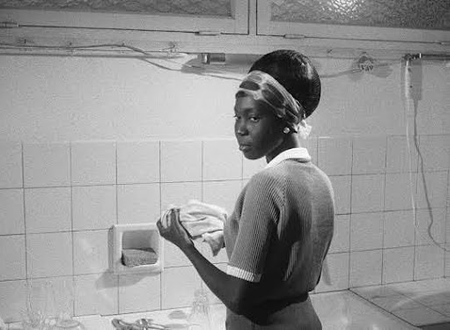
Diouana in the apartment kitchen
Double Consciousness, Psychological Control and Symbolism
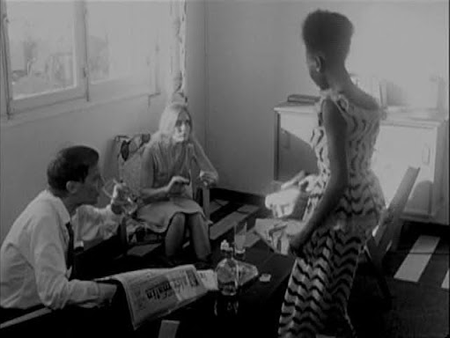
Scene from the film showing Diouana serving her employers
One of the most compelling ways to understand Diouana’s psychological decline is through double consciousness, a concept developed by W.E.B. Du Bois. Double consciousness describes the experience of seeing oneself through one’s own understanding while simultaneously being forced to see oneself through the gaze of a world that diminishes and defines you.
At the heart of the film is a crisis of identity shaped by colonial history. Diouana exists between two worlds but belongs fully to neither. She arrives in France with a sense of self shaped by hope, pride, and the belief that she is moving forward in life. However, the environment she enters reflects back a different identity, one in which she exists only as a servant, an object of curiosity, or a decorative presence. She becomes caught between who she knows herself to be and who she is permitted to be. The film shows how domination operates through economic dependence and perception. When a person is treated as an object long enough, the struggle becomes internal. Diouana’s tragedy is therefore social as it is psychological.
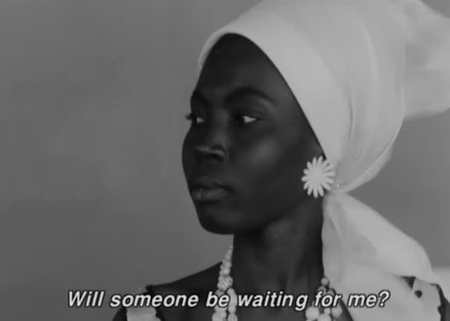
Close-up of Diouana with subtitle: “Will someone be waiting for me?”
Symbolism operates throughout the narrative. The mask Diouana gives her employers becomes a central visual metaphor. It represents cultural identity that’s valued aesthetically, as a decorative piece but stripped of meaning. It is welcomed as art while she herself is denied recognition as a full human being. Culture is appreciated when it is ornamental, but the person who carries that culture is controlled. The confined apartment space reflects psychological imprisonment, turning domestic work into a form of containment. Clothing, silence, and spatial distance communicate shifts in power. By the time Diouana dies, the film has made clear that her death is the tragic conclusion of a self that has been persistently fractured and denied coherence.
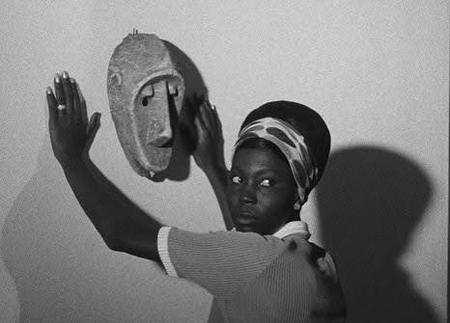
Diouana beside the mask on the wall
Afrikan Film, Design and Cinematic Language
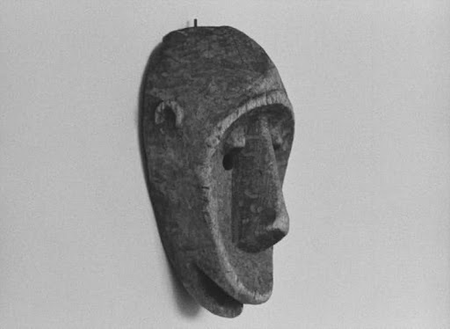
The carved mask as a central visual symbol in the film
As a work of Afrikan film and design, the film is remarkable for how deliberately it constructs meaning through visual restraint. The camera lingers on space, gesture, and repetition, allowing the environment itself to communicate domination. The apartment becomes both a workplace and prison, and the rhythm of domestic labour becomes a visual language of control. This approach challenges earlier cinematic traditions that reduced Afrikan figures to caricature by restoring interiority through stillness and observation. The film shows that design in Afrikan cinema is not only about beauty, but about politics and influencing how people are seen and understood as human.
Ousmane Sembène and the Film’s Legacy
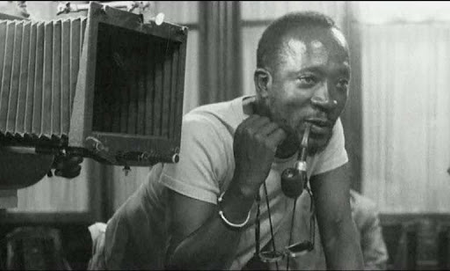
Ousmane Sembène
Through this work, Ousmane Sembène establishes cinema as a tool of Afrikan self-definition. He rejects romantic portrayals of Europe and challenges narratives that frame migration as automatic progress. His direction is deliberate and unsentimental, allowing everyday gestures to reveal structures of power. By positioning Afrikan experience at the center of the story rather than as background to European life, he claims authorship over representation and insists that Afrikan realities must be told by Afrikan voices.
The film marked a turning point for Afrikan cinema by demonstrating that Afrikan stories could confront global systems of power with intellectual clarity and artistic discipline. It opened a path for filmmakers to examine postcolonial realities without mediation and helped establish film as a space where Afrika speaks rather than being spoken about.