
July 17, 2026
Artist Profile: Ousmane Sembène
Ousmane Sembène altered how a continent was perceived on screen. As a filmmaker, writer, and uncompromising advocate for Afrika’s right to tell its own stories, he challenged colonial narratives and created a cinematic language rooted in the continent’s realities. Widely regarded as the Father of Afrikan Cinema, Sembène used film to reclaim culture and define the continent collectively.

Portrait of Ousmane Sembène.
Early Life and Formative Years
Born on January 1, 1923, in Ziguinchor, a coastal town in Senegal’s southern Casamance region, Ousmane Sembène emerged from the margins of what was then French West Afrika with a perspective that would later reshape Afrikan storytelling. His early life was defined by the textures of everyday survival. Sembène, the son of a fisherman, grew up immersed in the rhythms of coastal labour, watching, learning, and absorbing the quiet hierarchies and unspoken tensions embedded in daily life. These formative experiences would become the emotional and political backbone of his later work.
Sembène’s formal education was brief and abruptly cut short at around the age of 14 following expulsion after a physical dispute with a French teacher. In the years that followed, Sembène moved through a series of labour-intensive jobs, working as a stonemason, mechanic, and plumber. Each role placed him in direct contact with the working class, exposing him to the resilience and inherent dignity of ordinary people navigating structural hardship.
These experiences made Sembène develop a profound empathy that would come to define his artistic voice. Long before he ever picked up a pen or a camera, he was already documenting life by observing the intersections of labour, class, and colonial influence that would later become central themes in both his literature and films.
War, Work, and the Birth of a Writer
In 1942, Sembène was drafted into the Free French forces during World War II, serving in North Afrika and later in Europe. After the war, he remained in France, making a living as a dockworker in Marseille. It was here, amid the activist energy of the labour movement at the bustling port, that he began harnessing literature for social change.
While in Marseille, Sembène taught himself to read and write in French and became active in trade unions. His own work environment and the struggles of Afrikan workers in a European industrial landscape became the basis for his first novel, Le Docker Noir (Black Docker), published in 1956. The book announced him as a writer unafraid to address the realities of class, race, and colonialism. By drawing from his own experiences, Sembène built this debut around Diaw Falla, an Afrikan dockworker in Marseille who writes a brilliant novel only to have his manuscript stolen and published by a white writer. Diaw's tragic descent exposes the deep-seated racism, cultural theft, and socio-economic exclusion faced by Afrikan migrant labourers in post-war Europe.

Cover of Ousmane Sembène’s novel, Le Docker Noir.
Literary Success and Political Commitment
Writing soon became a potent expression of Ousmane Sembène’s commitment to telling Afrikan stories on Afrikan terms. In the late 1950s and early 1960s, he published several important works, including God’s Bits of Wood (1960), a sweeping account of the 1947–1948 Dakar-Niger railway strike that became a classic of anti-colonial literature. Rather than focusing on a single heroic figure, this masterpiece portrays a collective awakening across communities. It famously highlights the vital role of women who sustained their families during the gruelling labour dispute and marched over forty miles from Thiès to Dakar, placing female resistance at the centre of the pre-independence struggle. These books combined political urgency with layered portrayals of ordinary people, and they helped define Sembène as one of Afrika's most important post-colonial writers.
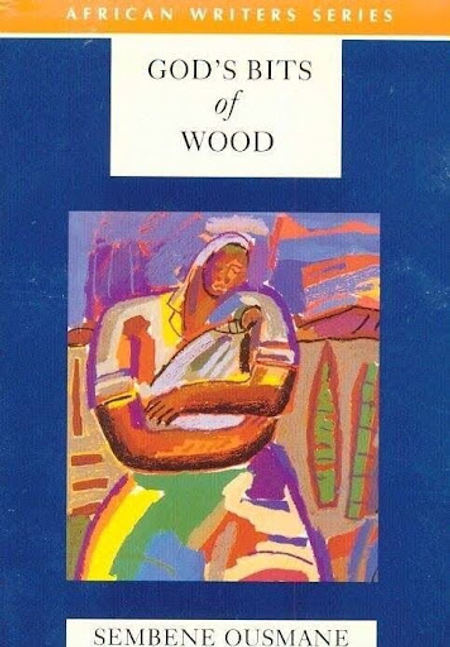
Cover of Ousmane Sembène’s novel, God’s Bits of Wood.
But there was a challenge: much of the Afrikan population he wanted to reach could not read French or could not read at all. Sembène understood that if he wanted to speak to broader Afrikan audiences, which include rural communities, the working class, and those excluded from formal education, he needed a different medium.
Cinema as the ‘People’s Night School’
This realisation marked the beginning of a new chapter in Sembène’s creative life. Determined to reach wider audiences, he travelled to Moscow in the early 1960s to study film at the Gorky Film Institute, a bold shift from the world of books to the world of cinema.
While his novels strongly explored themes of colonialism, class struggle, and Afrikan identity, they were limited by language and literacy, often reaching only a small, educated audience. Film, for Sembène, offered a more immediate and accessible medium that could communicate directly with wider Afrikan publics, including those outside formal education. Rather than marking a break from his writing, his filmmaking carried forward the same commitment to political storytelling. His focus on everyday people and his desire to use art as a tool for social consciousness remained consistent across both mediums. Cinema allowed him to expand his storytelling approach, moving beyond the constraints of written language into a more sensory and collective experience through visuals, sound, and performance.
On his return to Senegal, he began making short films and, in 1966, released La Noire de… (Black Girl), widely regarded as the first feature film by a sub-Saharan Afrikan filmmaker to gain international attention. Adapted from one of his own short stories, it demonstrated his command of both literature and cinema, winning the Prix Jean Vigo and launching a landmark filmmaking career. The film follows Diouana, a young Senegalese woman who moves from Dakar to France to work as a maid, expecting a beautiful, modern life. Instead, she is subjected to isolating, repetitive domestic servitude by her white employers. Her silent despair and eventual tragedy serve as a powerful, minimalist critique of the lingering psychological and structural chains of neocolonialism.
Recognising that language itself could be a barrier, Sembène soon made another revolutionary choice: he began making films in Wolof, the everyday language of Senegal. His 1968 satire Mandabi became the first feature film shot entirely in an Afrikan language, with French used in the voiceover to highlight the persistence of colonial power. It follows Ibrahima Dieng, an unemployed man whose attempts to cash a modest money order sent by his nephew in Paris turn into a bureaucratic nightmare. Sembène uses the humour of Dieng's tragicomic descent to critique the rampant corruption, modern greed, and alienation felt by ordinary citizen-subjects confronting the country's newly formed post-colonial administration. This move affirmed his commitment to filmmaking that truly spoke to Afrikan audiences on their own terms.
A Legacy of Cinema and Consciousness
Across his body of work, Sembène’s films explored themes of colonialism, corruption, tradition, modernity, gender, and power. His 1975 satire Xala offered a biting critique of the post-independence Afrikan bourgeoisie. It centres on El Hadji Beye, a wealthy, corrupt businessman who is struck by a curse of impotence, or xala, on the wedding night of his third marriage. This physical ailment serves as a political metaphor for the systemic impotence of the new ruling elites who remained culturally and economically dependent on their former colonial masters.
He then turned to precolonial Afrikan history with Ceddo (1977), which explores deep ancestral resistance to religious and cultural hegemony. By depicting the kidnapping of a royal princess to protest forced Islamic conversion and French imperial influence, Sembène championed the “Ceddo”, common non-aligned holdouts who fought to preserve ancestral culture and self-determination against foreign dogmas.
In Moolaadé (2004), his internationally acclaimed final film, Sembène focused on a powerful community drama highlighting female resistance to female genital mutilation. The film centres on Collé, a brave woman who uses the traditional protection ritual of moolaadé to shield young girls. The film positions Afrikan women as the active architects of moral progress and cultural reform in their communities. Through these works, Sembène made stories that were simultaneously personal and political, accessible yet profound.
Despite his growing international reputation, Ousmane Sembène frequently found himself in conflict with Senegalese authorities, unsettled by the political sharpness of his films. Works such as Xala openly critiqued post-independence elites and the failures of Afrikan leadership, leading to government censorship. Before Xala could be screened in Dakar, authorities reportedly demanded multiple cuts, a decision Sembène publicly protested. Yet these restrictions only reinforced his refusal to soften his vision. He remained committed to confronting power directly, insisting that cinema should challenge society rather than comfort it.
He made films to spark conversations, encouraging societies to reflect on themselves. For Sembène, cinema was “the people’s night school”, a classroom without walls where ordinary Afrikans could see their struggles and possibilities represented on screen.
Ousmane Sembène died in 2007 in Dakar, leaving behind a legacy that continues to inspire filmmakers, writers, and storytellers across Afrika and the world. What began with the lived experiences of a young son of a fisherman became a life devoted to cultural liberation.