
September 24, 2025
Exploring the Cultural Roots of Symbolism in Design
Logos are often the first element considered when designing a brand, largely due to their ability to create lasting first impressions and enhance recognition. However, limiting their value to these factors only scratches the surface of their true importance.

The Nazi Party’s emblem, the Swastika, was originally a symbol of auspiciousness found across various cultures, including Hindu, Buddhist, and indigenous European traditions.
Far from mere marketing tools, logos are deeply rooted in cultural and historical traditions. They are visual markers of identity tied to the more general practice of symbolism, a universal design language that has communicated meaning across centuries.
To truly grasp the current fascination with logos, we must examine the historical roots of symbolism in design and explore its role in shaping how we communicate visually today.
What is Design?
Design in its broadest sense is notoriously difficult to define. Its universality and multidisciplinary nature make it a boundless concept with applications in fields as varied as architecture, fashion, and industrial design.
Despite their diversity, all design forms have one thing in common: functionality. This focus on function was further emphasised by Victor Papanek, a 20th-century designer and educator, who defined design as “a conscious and intuitive effort to impose meaningful order.”
However, the design perspective we align with draws from Aristotle's framework of causality, emphasising the purpose ("why") and technique ("how"). While Papanek focused on problem-solving, this view highlights the equal importance of function and craftsmanship.
Simply put, design is where "functionality meets aesthetics to create effective and meaningful solutions."
A beautifully crafted chair that cannot support weight fails to serve its purpose, just as a functional but clumsy-looking chair lacks the artistry that defines design. For a design to resonate, it must communicate solutions in purposeful and beautiful ways.
Symbolism and Design
Communication is crucial in the design process. It shapes user understanding and determines a design’s success. The most effective designs go beyond their functions to communicate ideas, evoke emotions, and offer meaningful experiences.
This is where symbolism becomes indispensable. Acting as a bridge between a designer’s intent and the audience’s interpretation, symbols provide a visual language for expressing complex ideas to users.
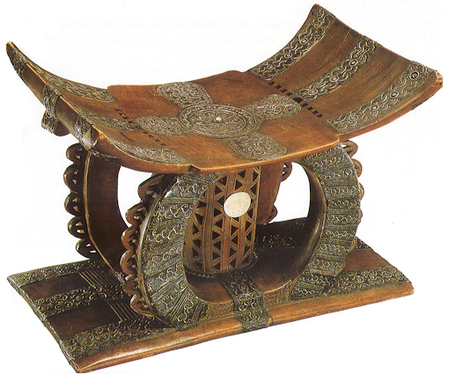
The Golden Stool (Sika Dwa Kofi) of the Ashanti people
Consider the Ashanti stools of Ghana, particularly the Golden Stool (Sika Dwa Kofi). If the Golden Stool were reduced to its functional purpose as seating, it would fail because no one is permitted to sit on it—not even the King.
Instead, the Golden Stool holds a far greater value as it is thought to contain the Ashanti nation's soul, and its symbols are intentional patterns meant to reflect this cultural and spiritual importance. Similarly, other personal stools in Ashanti culture are regarded as the seat of the owner's soul and are placed against walls when not in use to allow passing souls to rest.
Without symbolism, the true meaning of these stools would have been lost in translation.
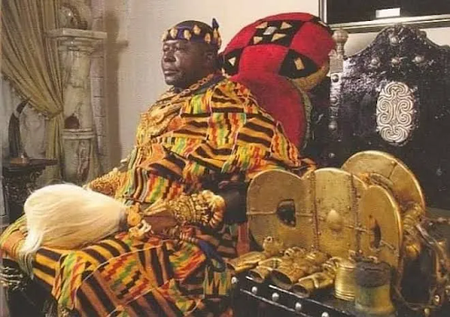
The Ashanti King seated beside the Golden Stool
Symbolism in Afrikan Design
The Golden Stool reminds us of symbolism’s integral role in Afrikan design. Rooted in storytelling traditions, many Afrikan cultures historically relied on visual symbols to preserve knowledge and tell stories before the widespread use of written scripts. These symbols carried deep cultural significance, reflecting the values, beliefs, and histories of their creators.
The relationship between Nsibidi symbols and the design of Ukara cloth is another compelling example of this tradition.
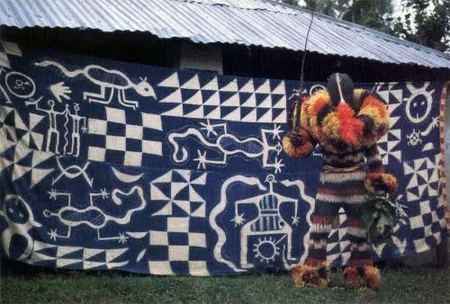
An Ekpe masquerade performance set against a Ukara cloth backdrop
The Ukara cloth, central to the secret Ekpe society of southeastern Nigeria, features an indigo-dyed surface adorned with Nsibidi symbols. These symbols, understood only by Ekpe initiates, immersed the cloth with layers of meaning.
The process of creating Ukara is as intentional as its purpose. Using traditional dyeing techniques, artisans craft fabrics personalised to reflect the wearer’s rank, wealth, or even their name in Nsibidi. Beyond being a garment, the Ukara also functions as a sacred object, usually draped over members during rituals or hung as a backdrop in holy spaces.
Today, Nsibidi symbols have reached beyond their original context. Designers, historians, and artists reinterpret its patterns, drawing inspiration for Afrocentric brands, logos, and art collectives.

The Nsibidi symbol for 'congress' featured in Black Panther
Despite these modern adaptations, Nsibidi and the Ukara cloth remain grounded in their origins: a marker of identity and a tool for communicating the Ekpe society's mysteries.
Symbolism's influence on design is profound, transforming objects into representations of identity, heritage, and purpose. In this sense, modern logos can be seen as extensions of this ancient tradition. Just as Nsibidi symbols identified members of the Ekpe society, contemporary logos have become global markers of identity and movements.
Take the raised fist, for instance—a symbol of resistance and solidarity that has migrated across cultures to become an emblem of civil movements worldwide.

The End SARS movement in Nigeria adopted the raised fist, repurposing it as a symbol of resistance against police brutality and a call for justice.
Through this, we can see that symbolism is an age-old tradition that continues to inspire the design world today.
Grafiki believes design goes beyond looking good. It’s about storytelling, building identity, and fostering meaningful connections. Throughout history, symbols have played an important role in connecting individuals and cultures to leave lasting impressions.