
September 26, 2025
Interview with Abby of The Studio by A.D.O.
Amarachika: Hello, Abby. Nice to meet you again.
Abby: Big surprise.
Amarachika: Can you tell us about your journey into textile design? What drew you to this medium?
Abby: Textile art. Not design. There’s a difference between textile artists and textile designers. Well for me, it's always been simple—it’s always been there.
For the longest time, I worked in fashion—as a fashion designer, fashion illustrator. But I’ve also always drawn. I love minimal, conceptual, and sometimes abstract drawings.
So basically, let me not digress. What led me to it. So I've been wanting to find myself a practice in art. But for some reason, I don't think I consider myself a visual artist, like a painter. But when I would draw for fashion, I’d often include needle and thread techniques—beading, patching, something with fabric. And that got me excited. Accentuating an outfit through fabric made me happy.
Then one day it just clicked: what if fabric is your medium? What if it’s your canvas?
I’ve always loved Calico fabric. When I’d make samples, I’d want to just stop there—just leave it in Calico. I loved how soft it was, how it showed lines, how minimal it looked. That’s me. So I thought, what if Calico is your canvas, and you draw with thread?
It became clear—I could make textile art by using fabric as my base and stitch my drawings into it. I started doing small pieces, patches, and people responded to them. Then I stopped for a while.
Last year, I decided to really go for it. I made a dress from start to finish. I’ve always dreamed of a practice that involved making clothes entirely by hand. I wanted to position myself as a brand doing that. But I realized that working as a brand meant listening too much to other people—customers, audiences—and that felt restrictive. I wanted full creative freedom. That’s when I decided to position myself as an artist.
Amarachika: That was very insightful. You actually answered my next question. But let’s go deeper—what traditions or practices in textile art do you see yourself working within, and which ones are you moving away from?
Abby: I want to embrace handcrafting—needle and thread, using simple stitches to create stories on fabric. I also want to experiment with what I call textile mixed media. I haven’t fully started that yet, but I plan to use accessories and different fabrics—tie them, stitch them down, use buttons and beads—still on Calico.
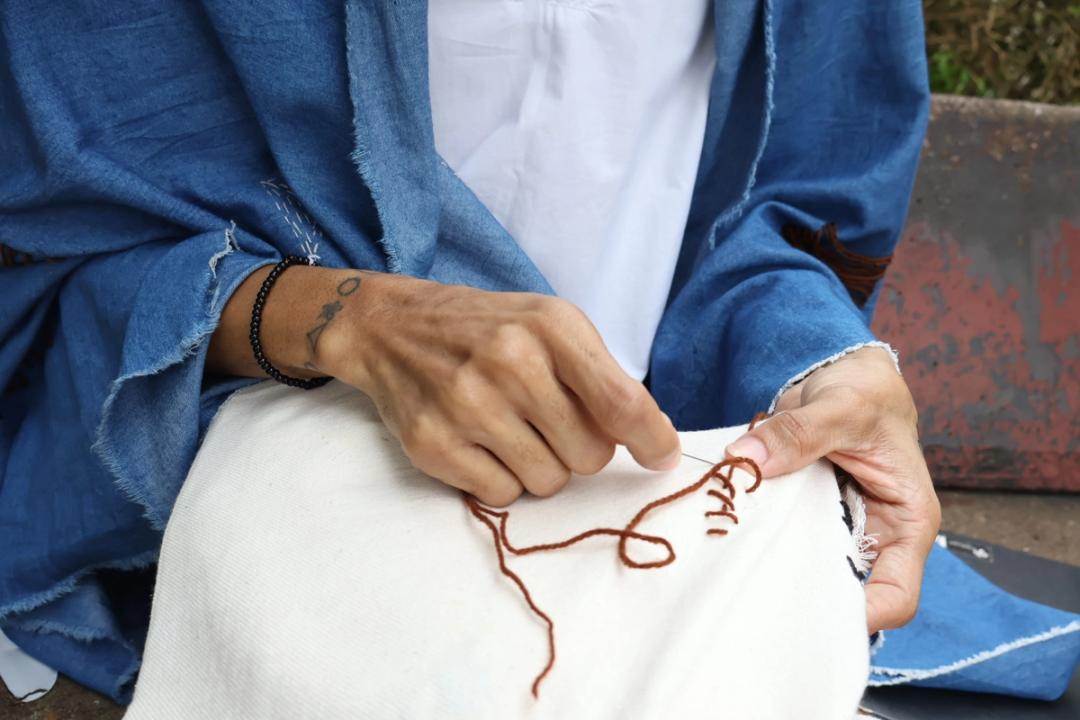
Photo by Ogungbamila Temitope (Milan)
What I’m not really into is dyeing. I might change my mind in the long run, but right now, it’s not for me. I’ve never liked messy processes—I like clean hands. Dyeing feels like painting in that way—it’s messy, and I don’t want to constantly wash up or worry about stained clothes. It just doesn’t suit how I like to work.
That said, I admire it. I have textile designer friends who dye and it fascinates me. I might collaborate with them in the future, but I don’t see myself doing it directly.
Amarachika: Your work often feels like it contains coded messages. What’s that about? And more broadly, what do you think of textile art as a means of communication?
Abby: I love that you noticed that. I’ve imagined a world where stitches and fabric carry messages. In my first piece—the dress—I included symbols that mean something to me: eyes, triangles, elemental signs. It’s a bit esoteric, but it’s always fascinated me.
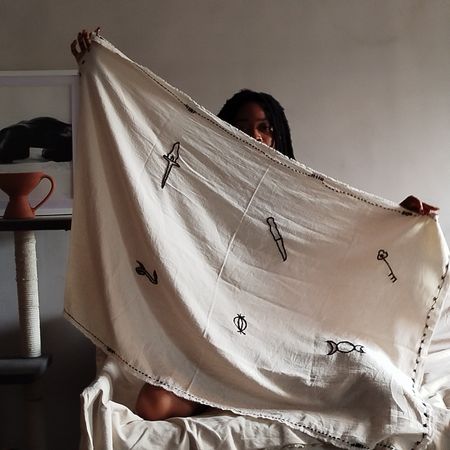
The Hecate Scarf
I did a scarf I called the "Hecate Scarf." It featured embroidered symbols of the goddess Hecate, whom I worship. There’s another piece I made—I called it "Home." I was exploring what “home” means. I kept asking, what makes a place feel like home? Is it class? Is it aesthetics? Or is it just internal peace? I stitched small squares, each one with a different technique. For me, that represented differences—different ways to experience or define home.
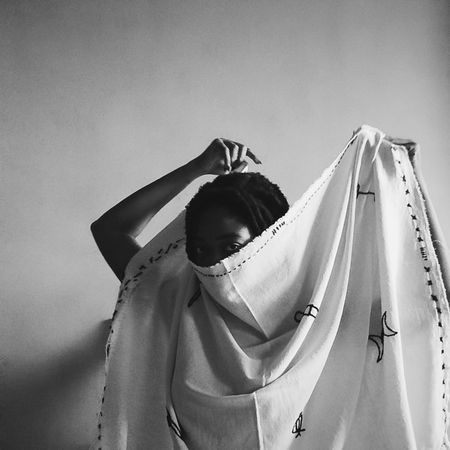
The Hecate Scarf
Yes, there are coded messages, and I try to share them when I present the work. It’s very conceptual and subtle. Not everyone does this in textile art, and that’s okay. Some people create very abstract or lifestyle-focused work, and I appreciate that too.
But for me, it’s about attention. The work is minimal, but it pulls you in. It needs you to sit with it, to read it. That’s the kind of textile art I want to make.
Amarachika: You mentioned something earlier about your work having a spiritual dimension. Can you speak more on how art, design, and spirituality meet in your studio? Is there a particular state of mind or ritual in your creative process?
Abby: It felt really good. It felt like an accomplishment. I think the ritual usually starts from when the idea comes. What I try to do is honor every idea that comes to me. Some ideas that come now may not be created until next year or the year after, but I honor all of them. That in itself is a ritual.
The process really begins in my mind. When I conceive the idea and think about how to present it, that’s when it starts. Some ideas are personal, others about something bigger. But from that moment, I begin a kind of internal ritual. Like with the scarf I made dedicated to Hecate — the goddess I worship — I used her symbols: the athame, the torch, the serpent, garlic, the triple moon. It all came together as part of the ritual of making.
Amarachika: That’s really fascinating. You’ve previously defined your work as "art, design, and spiritual practice". Could you unpack that further?
Abby: Yes. Initially, I positioned my work as a brand — Studio by A.D.O — that would focus on making everything by hand, from start to finish. At the beginning, I defined my practice as art, design, and spirituality.
The art comes from my drawings — minimal, conceptual, line-based illustrations on fabric. The design aspect is in the garments I make. And spiritually, I’ve always wanted to use esoteric elements and symbols in my work. Things that mean something. Now, I find that a lot of what I make comes from a deeply personal space, but I still see that as spiritual. We're told not to separate spirituality from everyday life. So to me, personal work is spiritual work.
Amarachika: How does it feel to be a textile artist right now, especially in this part of the world?
Abby: Honestly, it feels very lonely. Like I'm not being heard. I apply to programs and residencies where I know my work could fit — because what I do is different — but textile is still seen mostly as a material for fashion. People assume anything textile is fashion-related. But what I do isn't fashion in the conventional sense.
My work is small in scale — maybe just a half-yard of fabric — but it’s layered with drawing, thread, texture. It’s installation work. It's conceptual. And that can be hard to communicate to the average art viewer or gallery. A friend once told me that conceptual art needs space — because the space is part of the concept — and that makes it harder to collect.
Sometimes I wonder: will people get it? But I've decided to just keep doing it. It’s therapeutic. I stitch every day. Even a few stitches. It's more than a practice — it’s a kind of meditation.
Amarachika: And how do you feel about Afrikan textiles in global design conversations?
Abby: I’m glad that the narrative around Afrikan textiles is changing. For a long time, when people thought of Afrikan fabric, they only thought of Ankara. But Ankara isn’t the full story — and it’s not even Afrikan in origin. Now we’re seeing people returning to actual hand-crafted traditions: tie-dye, weaving, embroidery.
Afrikan textiles are finally being seen in their full diversity and depth. And with the growing conversations around Afrikan luxury and craftsmanship, it's finally being appreciated. You can now explain the value of a handmade piece and why it costs what it does. That shift is happening, and I hope it continues — especially for textile art, which still lags a bit behind textile design in that recognition.
Amarachika: Final question. If your fabrics could speak, what would they say?
Abby: Oh, they’d say a lot. They’d cry. They’d whisper. They’d shout. They’d say, “Don’t look at me,” and also, “Look at me.” They’d say, “This is what I’ve been through.”
There’s a piece I’m working on next called Look At My Scars. That title came because I imagined the fabric literally showing you its history. Another recent piece is based on a quote I heard in a cartoon — I traced it back to the author and I’m embroidering it onto fabric. These pieces would speak poetry. They’d be emotional. Vulnerable. Maybe even overshare. But they’d definitely have something to say.
Cover Photo by Ogungbamila Temitope (Milan)