
May 20, 2026
Spotlight: Fanti Carnival
On the streets of Lagos Island, something remarkable takes place every year. Troupes of men and women in elaborate, handcrafted costumes, accompanied by lively musical bands and choreography passed down through generations, pour into the streets once more. This is the Lagos Fanti Carnival, a revived celebration rooted in one of Nigeria’s most historically layered cultural traditions.
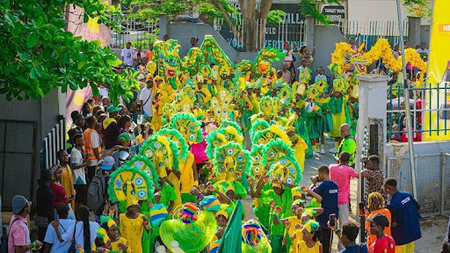
Lagos Fanti Carnival troupe in elaborate green and yellow costumes
The name “Fanti” itself is widely believed to derive from the Portuguese word fantasia, meaning “fantasy”, a nod to the ornate costumes and decorated headpieces worn by participants.
But call Fanti a “carnival” and you risk underselling it.
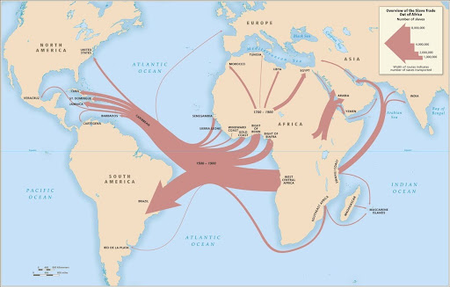
Map showing transatlantic slave trade routes
To understand the Fanti Carnival, you must first cross an ocean. Twice. From the 16th to the 19th century, the transatlantic slave trade forcibly displaced millions of Africans to the Americas, among them a large number from what is today Nigeria and the broader West African coast. In Brazil, these men and women were stripped of their names and their freedom, but not entirely of their culture. Yoruba religion, music, and traditions survived, threading themselves quietly through Brazilian life in ways that would only become visible centuries later.
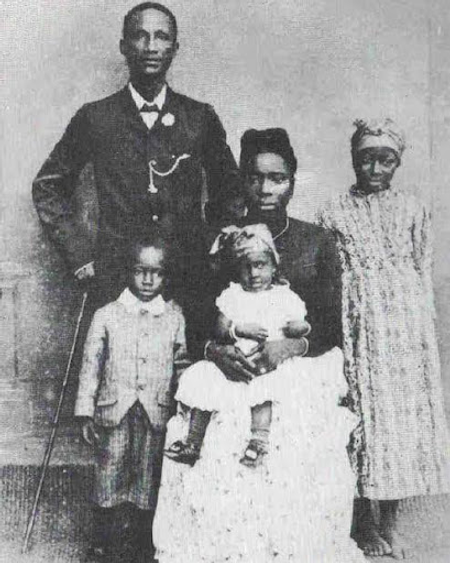
Historic photograph of an Afro-Brazilian family
When Brazil moved toward abolition in the 19th century, some of those who had been enslaved chose to return. They came back to West Africa carrying everything they had built in exile: Portuguese architecture, Catholic faith, Brazilian food, samba rhythms, and the tradition of carnival celebration. They were called the Aguda.
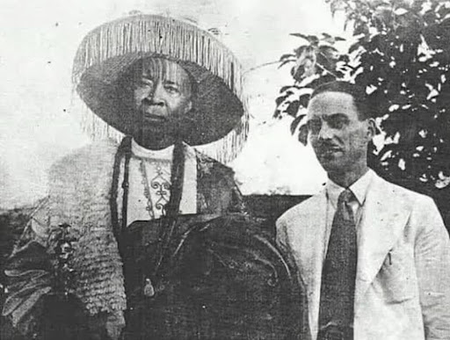
Historic image of Aguda figures in Afro-Brazilian dress
The Aguda settled primarily on Lagos Island, in what became known as Popo Aguda, the Brazilian Quarters, in today’s Campos district. They were a community caught beautifully between two worlds, and they built a life that honoured both.
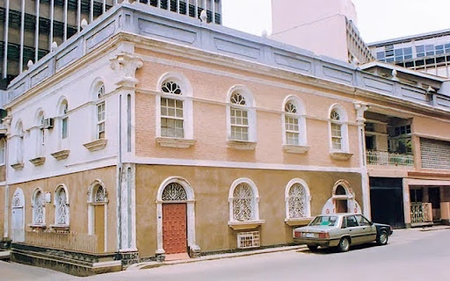
Afro-Brazilian architecture in Lagos Island
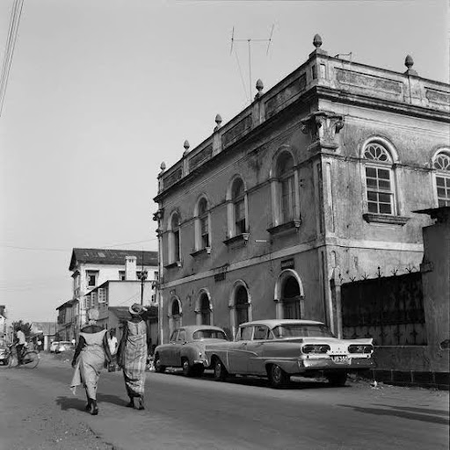
Historic building in Lagos Island
The carnival began simply as an Easter Sunday gathering, with music and colour. But it grew, absorbing into neighbourhoods. Districts formed their own troupes. Friendly rivalries emerged as the costumes grew more elaborate, and what had begun as a religious observance became a declaration of identity. This is who we are. This is where we come from. We are many, and we are here.
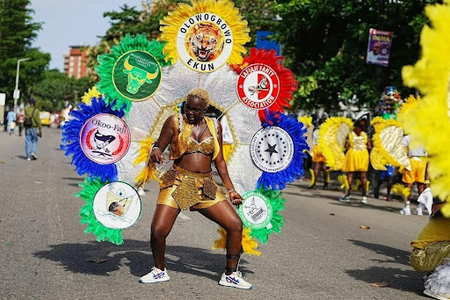
Carnival performer wearing district emblems and colourful headpiece
The Fanti Carnival was created by the communities themselves, who formalised the celebration and gave it structure, colour, and identity. They are Brazilian Campos, Olowogbowo, and Lafiaji.
Brazilian Campos
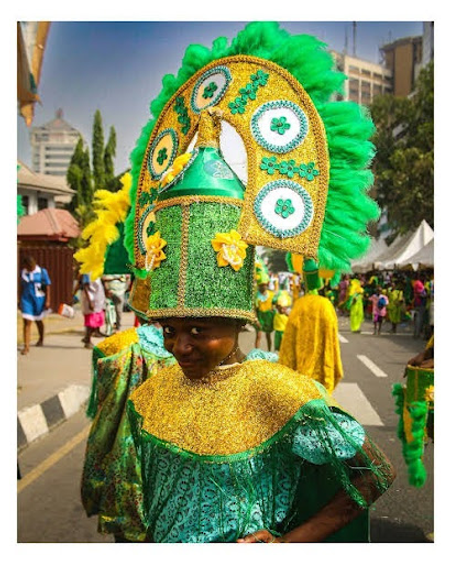
Brazilian Campos performer in green and yellow costume
Brazilian Campos, marked by green and yellow and symbolised by the bull, the “Great Campos”, is the historic heartland of the Aguda community. Known as the original Aguda settlement, or Popo Aguda, it was here that the returnees first put down roots and where the Lagos Fanti Carnival was born.
Olowogbowo
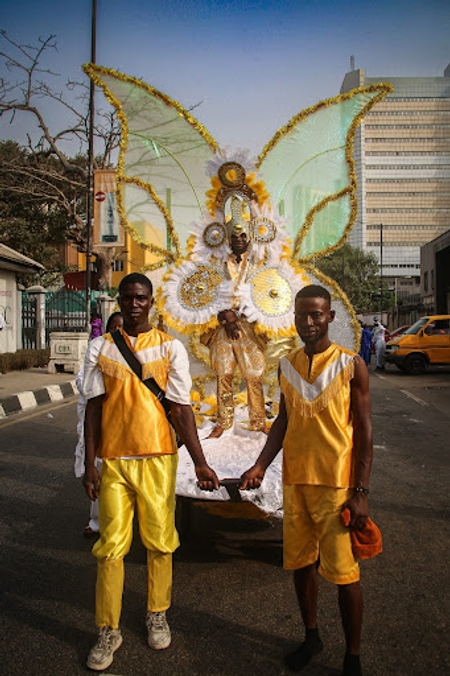
Olowogbowo carnival performers in yellow and white costume
Olowogbowo, marked by yellow and white and symbolised by the tiger, is formally known as the Illustrious Olowogbowo Fancy Carnival Association. Their signature is flawless, perfectly synchronised choreography, where precision itself becomes performance.
Lafiaji
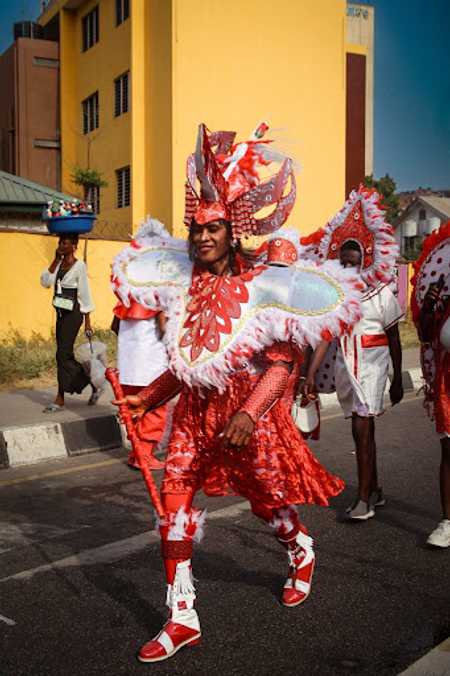
Lafiaji carnival troupe in red and white costumes
Lafiaji, marked by red and white and representing the Eastern Axis, was formerly known as the Lafiaji Boys and Girls. Their contingent carries flags bearing historic symbols.
The Seven Districts
Over time, four more districts joined the carnival family. Okoo-Faji, marked by blue, red, and white and inducted in 1997, is known for youthful energy and athletic choreography, drawing some of the loudest crowd reactions. Epetedo, also inducted in 1997 as the Epetedo United Youth Movement, blends modern innovations into traditional forms. Okepopo, marked by green and white, is disciplined and precise, each movement a statement of community pride. Isale-Eko, the historic core of Lagos Island, carries the weight of the island’s oldest identity with dignified grace. Together, these seven districts preserve and perform their heritage.
Revival and Cultural Memory
The Lagos Fanti Carnival celebrates Afro-Brazilian heritage and the history of the Aguda returnee community on Lagos Island. Traditionally held around Easter, it is rooted in neighbourhood associations and expresses community pride through district troupes and historic costumes. The Lagos Carnival, part of the Lagos Black Heritage Festival, is a broader city-wide celebration designed to showcase the many cultures of Lagos through tourism, spectacle, and large public performances.
The decline of the Lagos Fanti Carnival was closely tied to changes on Lagos Island. As the city modernised, many descendants of the Afro-Brazilian Aguda community sold historic family properties or moved elsewhere, while redevelopment replaced many distinctive buildings. With the community base gradually dispersing and little institutional support, the carnival eventually lost momentum and went dormant around 2010.
The Lagos Fanti Carnival returned in 2025 after decades of dormancy, with all seven historic districts uniting under a single banner and the Lagos State government providing support. Community archives were opened, reconnecting people with their shared history. The revival is more than a parade for participants, deeply personal. It is a reclamation, showing that the descendants of the Aguda still carry their colours and know their history, with children watching their grandparents dance and grandparents seeing their grandchildren carry the same flags.
A museum keeps history behind glass, and a textbook keeps history behind words. But the Fanti Carnival keeps history alive in the streets, in the costumes, in the music, and in the choreography passed down through generations. The celebration is the work of a community maintaining its heritage, connecting the past with the present. This is what the Lagos Fanti Carnival is. Not a relic. But a living archive, the kind that dances.
Ayo Ibile and the Living Archive
The carnival's revival has not gone unnoticed. Ayo Ibile, a cultural initiative celebrating the richness of Lagos carnival traditions, began as a collection of images and the idea for a photography exhibition but has since evolved into something larger: a cultural project dedicated to celebrating the richness of culture and community.
Perhaps what makes Ayo Ibile most significant is its relationship to the community. Developed in collaboration with host communities, the project was built on a foundational principle: that this work belongs to the people as much as it belongs to the artists. By bringing the exhibition to the streets rather than into galleries, Ayo Ibile did something quietly radical: it liberated the images, making them accessible, and turned cultural celebration into a communal experience for everyone.
In this way, Ayo Ibile mirrors exactly what the Fanti Carnival has always been: a living, public act of cultural memory.